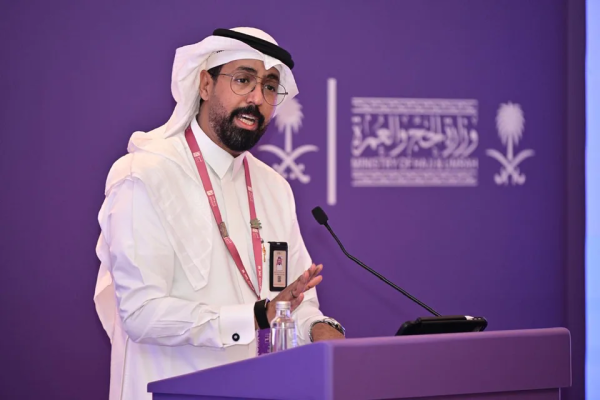
The Ministry of Hajj and Umrah highlighted the key features of the sixth edition of the Hajj Conference and Exhibition during a press briefing held in Jeddah today, Saturday. The event, which plays a crucial role in early preparations for the upcoming Hajj season, is set to commence on Sunday in Jeddah under the patronage of the Custodian of the Two Holy Mosques, King Salman bin Abdulaziz Al Saud. It is organized by the Ministry in collaboration with the Guests of God Service Program, one of the initiatives of Saudi Vision 2030.
Dr. Ghassan bin Rashid Al-Nuaimi, Assistant Undersecretary for International Relations and the official spokesperson for the Ministry of Hajj and Umrah, emphasized that the care for the Two Holy Mosques and the service of pilgrims and Umrah performers is a steadfast approach adopted by the Kingdom since its unification by King Abdulaziz bin Abdulrahman Al Saud. This approach has continued through various stages of the Kingdom's development, with Saudi Vision 2030 enhancing the pilgrim experience by facilitating rituals, improving service quality, enriching the religious and cultural experience, and boosting the system's efficiency and sustainability.
Dr. Al-Nuaimi explained that the Guests of God Service Program has translated this priority into developmental, organizational, and service initiatives and projects, supporting early planning, integration, and readiness among various concerned entities, with continuous oversight from the Supreme Hajj Committee chaired by His Royal Highness Prince Abdulaziz bin Saud bin Naif bin Abdulaziz.
He noted that the Hajj Conference and Exhibition is an extension of this path and one of the main stations for early preparation for the upcoming Hajj season. It brings together entities, Hajj affairs offices, service providers, companies, and specialists to discuss needs, develop solutions, build partnerships, and complete arrangements and contracts that reflect on the quality of services provided to the Guests of God.
He pointed out that the conference has expanded year after year in its scope, content, and impact, becoming an international platform that gathers decision-makers and specialized entities in organizing and managing the Hajj system. Its previous five editions witnessed over 1,850 agreements for providing services to the Guests of God, more than 310 sessions, and 250 workshops, attracting over 570,000 visitors.
He revealed that the sixth edition will see participation from over 520 entities from governmental, private, and non-profit sectors, with attendees and participants from more than 150 countries, spanning an area exceeding 67,000 square meters across more than 15 main zones and programs.
Detailing the scientific program, the spokesperson explained that it is divided into three main tracks: infrastructure and operational services, empowerment and integration, and development and sustainability. These tracks cover topics such as transportation, logistics, housing, catering, health, digital transformation, innovation, training, and enriching the Guest of God's experience.
Dr. Al-Nuaimi highlighted that the conference includes the 'Hajj Council,' providing a space for dialogue among leaders, specialists, researchers, and entrepreneurs, alongside the accompanying exhibition that brings together fields of aviation, transportation, hospitality, health, technology, media, innovation, and entrepreneurship, as well as the business center, partner platform, and specialized oases, connecting entities with needs to those capable of providing solutions.
He announced that the sixth edition will launch the 'Awareness and Training Forum' for the first time under the slogan 'From Awareness to Empowerment,' aiming to develop awareness tools, enhance the efficiency of training programs, and boost the readiness of workers serving the Guests of God through specialized programs and experiences.
He affirmed that innovation has a prominent presence through the 'Innovation Zone,' the 'Future of Hajj Innovations' camp, and programs dedicated to startups and innovators with ideas and solutions, aiming to transition solutions from concept to experimentation and development, linking innovators with actual challenges and needs in the Hajj system.
Dr. Al-Nuaimi concluded by emphasizing that the true value of the conference lies in the impact of its outcomes after its conclusion, by transforming meetings into agreements, agreements into contracts, discussions into action plans, and ideas into solutions and projects that reach the field and reflect on the pilgrim's experience. He noted that the Hajj journey begins months before the pilgrim's arrival in Mecca, through early planning and preparation, partner meetings, clear roles and responsibilities, plan reviews, and service testing, contributing to a smoother and more reassuring pilgrimage journey.
He noted that the conference's slogan, 'From Mecca to the World,' reflects the status of Mecca and the accumulated Saudi experience in managing and organizing Hajj and Umrah seasons, handling large crowds, developing services, and employing technology and innovation, opening the door for developing solutions and building partnerships with entities and specialists from around the world.
